From Little Faith to the Faith of Jesus

Updated: Aug 16

Article by:
George A. Beckett, Sr., MA
August, 2026
What Is Faith?
To understand the biblical progression of faith, we must first understand what Scripture means by the word faith. Strong’s Biblical Concordance helps with the Greek definition of the word faith. It comes from the word pístis /peithô, "persuade, be persuaded"; properly, persuasion (be persuaded, come to trust); faith. The idea is one of persuasion that leads to trust, confidence, and reliance. Biblical faith, therefore, is not merely intellectual agreement with something we believe to be true; it involves being persuaded to trust the one in whom that faith rests.
This understanding is important because faith ultimately has an object. When we place our faith in Jesus Christ, we are persuaded to trust Him as He is that object of faith. As we come to know Him through His Word and our relationship with Him, that trust develops. Jesus said, “If you abide in My word, you are My disciples indeed. And you shall know the truth, and the truth shall make you free” (John 8:31–32). The more we know Christ, the more we learn to trust Him. Yet the purpose of that growing trust is not simply to become more confident in ourselves or in our own ability to believe. It is to move us toward the complete dependence upon God that Jesus Himself demonstrated toward His Father.
One Faith, but Different Stages of Development
The Bible declares that there is “one Lord, one faith, one baptism” (Ephesians 4:5). If there is only one faith, however, why does Scripture also speak about little faith, weak faith, and strong faith? Jesus spoke of “little faith” (oligopistos) in passages such as Matthew 6:30, while Paul referred to those who were “weak in faith” in Romans 14:1 and encouraged believers to “stand firm in the faith” in 1 Corinthians 16:13. These passages do not require us to conclude that there are different faiths. Rather, they reveal that believers can be at different stages of spiritual development and can exercise the one faith with different degrees of maturity and application.
The distinction, therefore, is between the one faith and the believer's development in that faith. The faith itself does not become different from one Christian to another. The believer grows in his understanding, trust, surrender, and application of that faith. One Christian may still be in an early stage characterized by “little faith,” while another may be operating primarily from what he understands as “my faith,” and another may discover that his faith is weak when a particular circumstance challenges his trust in God. These conditions do not create separate faiths. They describe where individual believers are in their spiritual development.
This development begins when a person accepts Jesus Christ. At conversion, the believer genuinely trusts Christ for salvation, but accepting Jesus as Savior does not mean that the believer has immediately learned to rely upon God in every area of life. Salvation begins the relationship; sanctification is the continuing work through which God transforms the believer's life. As Paul explains, “He who began a good work in you will carry it on to completion until the day of Christ Jesus” (Philippians 1:6). The Christian therefore begins with genuine faith but continues growing in how that faith is understood and applied.
Little Faith: The Beginning of Trust
Jesus' reference to “little faith” helps illustrate this early development. In Matthew 6:30, Jesus challenged His disciples because they were anxious about what they would eat and drink. Also, they were concerned about a storm that they were in. He reminded them that their heavenly Father already knew their needs and asked why they were so anxious if God cared for them. He concluded by asking, 'Why are you so afraid, you of little faith?' Matthew 8:26.
Jesus was not telling them that they possessed a false faith. He was exposing an area in which their trust in God had not yet developed sufficiently. They knew God, followed Jesus, and had already experienced His power, yet their concern about physical necessities revealed that they had not fully extended their trust to that area of life. Their faith was real, but their understanding and application of that faith were still developing.
This is often where the Christian life begins. A person may genuinely trust Jesus for eternal salvation while still depending heavily upon his own ability to control his finances, relationships, health, career, or future. The Christian may know that Jesus is Savior while still learning that He is also Lord over every area of life. Jesus did not call His followers merely to trust Him for eternity; He called them to follow Him in everything. “If anyone desires to come after Me, let him deny himself, and take up his cross, and follow Me” (Matthew 16:24).
From Little Faith to “My Faith”
As the Christian grows, faith becomes increasingly personal. He begins to speak of “my faith” because he has personally placed his trust in Jesus. This is a natural part of spiritual development. Paul himself could speak personally about faith, saying, “The life which I now live in the flesh I live by faith in the Son of God” (Galatians 2:20).
The problem arises when “my faith” becomes centered on the believer rather than on Christ. Christians can begin to think of faith as something they possess independently, as though the strength of their Christian life depends primarily upon how strongly they themselves can believe. Scripture continually redirects that focus toward Christ. The strength of faith is not ultimately found in the believer's ability to believe but in the One whom the believer trusts.
This is why spiritual maturity requires more than simply saying, “I have faith.” The more important question is, whom am I trusting, and am I willing to trust Him wherever He leads me? Faith is not merely something we claim to possess; it is trust being exercised toward God.
Weak Faith: When Trust Is Tested
As Christians mature, circumstances expose areas where their trust has not yet become complete. This is where what Scripture calls “weak faith” becomes significant. Romans 14:1 speaks of receiving “one who is weak in faith,” showing that a genuine believer can have weakness in his faith without being rejected by God or excluded from the body of Christ.
Weakness in faith can become evident when a believer encounters a situation in which trusting God requires surrendering something he has previously controlled himself. A Christian may trust Jesus for salvation but struggle to trust Him with finances. He may trust God with his eternal future but attempt to control every aspect of a relationship. He may believe that God is sovereign but become overwhelmed by fear when his circumstances become uncertain.
These situations reveal that spiritual growth is not simply about learning more biblical information. It involves moving from dependence upon what is visible and controllable toward dependence upon the unseen God. Paul expressed this principle when he wrote, “For we walk by faith, not by sight” (2 Corinthians 5:7). The Christian's faith is being developed whenever he learns to trust God beyond what his natural understanding can see.
The Problem of Compartmentalized Faith
This is where faith can become compartmentalized. A believer may trust Christ completely in one area while continuing to rely upon himself in another. He may say, “I trust Jesus with my salvation,” while effectively saying through his actions, “But I must handle this part of my life myself.”
Jesus is Lord over all of life, not merely the spiritual portions of it. Proverbs 3:5–6 provides the principle: “Trust in the LORD with all your heart, and lean not on your own understanding; in all your ways acknowledge Him, and He shall direct your paths.” The words “all your heart” and “all your ways” point beyond a limited religious trust toward a life increasingly surrendered to God.
James describes the instability that occurs when a person is divided in his trust. James 1:6–8 compares the doubting person to a wave of the sea and calls him “double-minded” and “unstable.” The issue is not that the Christian has acquired another faith. Rather, the believer is attempting to live between dependence upon God and dependence upon himself. Sanctification progressively exposes that divided reliance and calls the believer toward wholehearted trust.
Faith Develops Through Testing
God uses the circumstances of life to expose and develop the believer's trust. James writes, “The testing of your faith produces patience” (James 1:3). Peter similarly explains that the genuineness of faith is tested through trials (1 Peter 1:6–7). These experiences can reveal areas in which a Christian says he trusts God but has not yet learned to rely upon Him completely.
This does not mean that God is simply trying to make Christians acquire a larger quantity of faith. Rather, He is teaching them to surrender increasingly more of their lives to Him. A Christian may discover that he has trusted Jesus for salvation but has never really surrendered his fears, finances, relationships, plans, or future to God. Each area becomes an opportunity for the believer to move away from self-reliance and toward dependence upon God.
This is part of sanctification. Paul describes this transformation as a process in which believers are being transformed into the image of Christ (2 Corinthians 3:18). Spiritual maturity therefore involves becoming increasingly like Christ not merely in outward behavior, but in the way we trust and depend upon the Father.
“I Believe; Help My Unbelief”
The encounter recorded in Mark 9:24 provides a powerful picture of developing faith. A father seeking healing for his son cried out to Jesus, “I believe; help my unbelief!” His statement reveals that genuine trust and unresolved doubt could exist together within the same person. He did not pretend that his trust was complete. Instead, he brought the very weakness of his faith to Jesus.
This is an important part of spiritual development. When God exposes an area in which our trust is weak, the answer is not to pretend that we are stronger than we are. We bring that weakness to Christ. The believer's recognition of weakness can become the very place where dependence upon Christ deepens.
The Christian life therefore involves repeatedly discovering areas where self-reliance remains and bringing those areas under the lordship of Christ. What begins as trust in Jesus for salvation progressively expands into trust in God throughout the whole of life.
“Increase Our Faith”
This helps us understand the apostles' request in Luke 17:5: “Increase our faith.” The disciples were still learning what faith meant and were asking Jesus to increase their capacity to trust. Jesus' response directs their attention away from measuring faith by quantity and toward the reality of genuine trust in God.
The disciples were learning that faith is not ultimately about how impressive their own ability to believe might become. Jesus was teaching them to depend upon God rather than themselves. Throughout His earthly ministry, Jesus repeatedly demonstrated this dependence upon His Father. He said, “I do nothing of Myself; but as My Father taught Me, I speak these things” (John 8:28). He also said, “I do not seek My own will but the will of the Father who sent Me” (John 5:30).
Jesus therefore provides the perfect pattern of faith: complete trust, dependence, and obedience toward the Father. His life demonstrates what humanity was created to experience—a relationship with God in which dependence upon the Father replaces independent self-reliance.
From “My Faith” to the Faith of Jesus
As the Christian matures, the focus gradually moves from “my faith” to the faith of Jesus. This does not mean that the believer stops personally trusting Christ. Rather, the believer increasingly recognizes that his confidence should not ultimately rest in his own ability to believe. His faith must rest in Christ and increasingly reflect the faithfulness, trust, and obedience that Jesus demonstrated toward His Father.
Paul expressed this transformation when he wrote, “I have been crucified with Christ; it is no longer I who live, but Christ lives in me” (Galatians 2:20). He continued, “the life which I now live in the flesh I live by faith in the Son of God, who loved me and gave Himself for me.” The Christian's spiritual development is therefore a movement away from self-reliance and toward Christ-centered dependence.
The believer begins by trusting Jesus. He then learns to trust Him beyond salvation and into the circumstances of everyday life. As sanctification continues, areas of weak or undeveloped faith are exposed. Through those experiences, the Christian learns to surrender control and rely upon God rather than what he can see, understand, or accomplish himself. The goal is not to manufacture a stronger version of human faith but to increasingly live by the faith that is centered in Christ.
The One Faith
There is therefore no contradiction between Paul's declaration that there is “one faith” (Ephesians 4:5) and the Bible's descriptions of little, weak, and strong faith. There is one faith, but believers are at different stages of development in their understanding, trust, and application of that faith.
One Christian may be beginning with little faith. Another may have developed a personal confidence expressed as “my faith.” Another may discover weakness when his trust is tested in a particular area of life. Another may have learned to surrender that area and rely more completely upon God. These differences do not create different faiths. They reveal different levels of spiritual development as believers learn to live by the one faith centered in Christ.
The ultimate direction of this development is not toward greater confidence in ourselves but toward greater dependence upon God. Jesus perfectly demonstrated this dependence in His relationship with the Father. Therefore, spiritual maturity is not simply learning to say, “I have strong faith.” It is learning to say, in effect, “I no longer need to depend upon myself. I trust God because I have come to know who He is, and I am willing to place every area of my life in His hands.”
Conclusion
Faith, then, is not ultimately measured by how much confidence we have in ourselves. It is demonstrated by whom we trust/ have faith in. The Christian life begins with trusting Jesus for salvation, but sanctification progressively teaches the believer to extend that trust into every area of life. What begins as little or developing faith can mature as the believer moves from human reliance to spiritual dependence upon the unseen God. The destination is not another faith, but a fuller participation in the one faith revealed through Jesus Christ: He replied, 'Why are you so afraid, you of little faith?' Jesus’s faith is perfect trust and obedience to His Father. We can have that also.
Make up your mind to surrender each area of your life to Jesus. As you learn to rely on His faithfulness rather than allowing the world to determine your decisions, you can experience the stability, peace, joy, and security that come from trusting Him. Jesus does not promise that the circumstances around us will always be calm, but He teaches us how to remain anchored in Him when the waters are not. The goal is not simply to have faith in one part of life while holding another part back; it is to allow the faith of Jesus to shape how we trust God and live in every area of our lives.
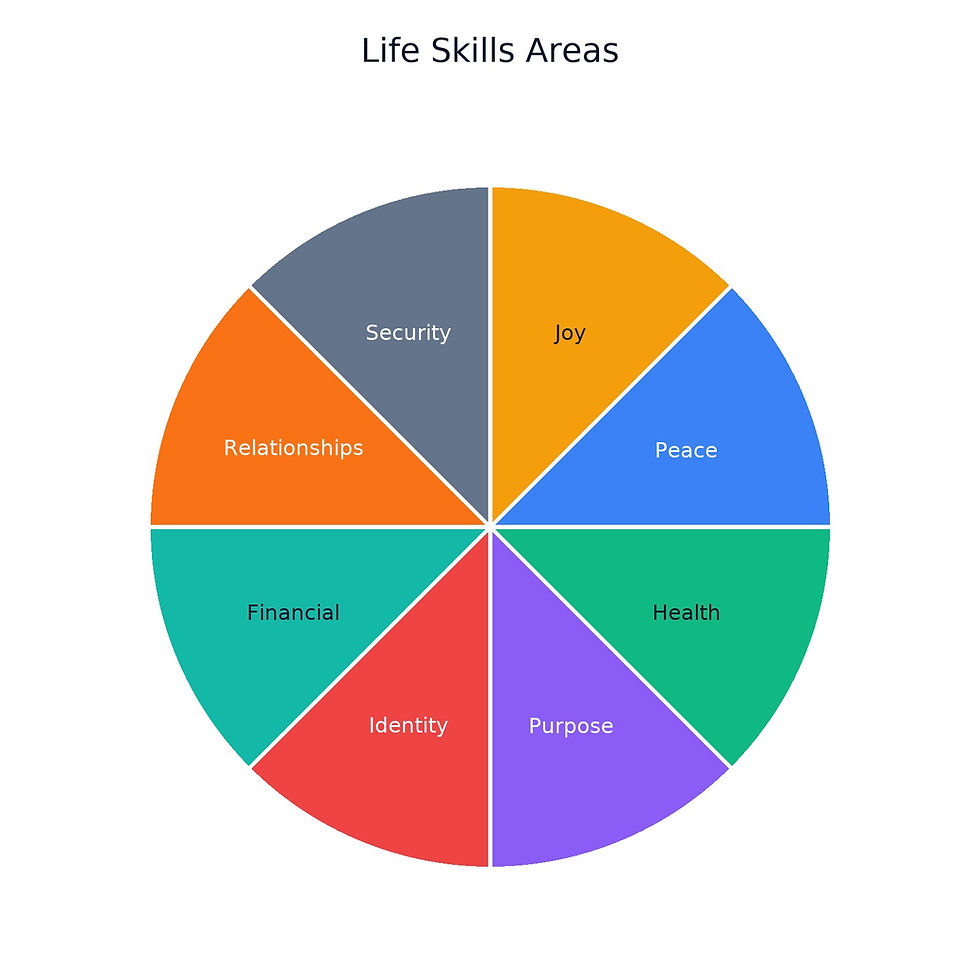
The areas below in the pie chart represent the parts of life in which we are called to trust Jesus. But consider what happens when one area has not been fully surrendered to Him. If you have everything else in order, but have no joy, would that lack of joy affect your peace? Would it affect your sense of security, your relationships, your purpose, or even how you understand your identity in Christ? The areas of our lives are connected, and withholding one area from Jesus can influence the way we experience and respond to the others. If one area of the pie chart is not trusting in the Lord, then where does the ultimate decision to act in that area come from if not from Jesus, who has the one Faith of God?
The below pie chart and spiritual wholeness are from Dr. Creflo Dollar's ministry.

Comments