The Doctrine of Finished Grace and Covenant Wholeness

Updated: Aug 14
Article by:
George A. Beckett, Sr., MA.
June 2026
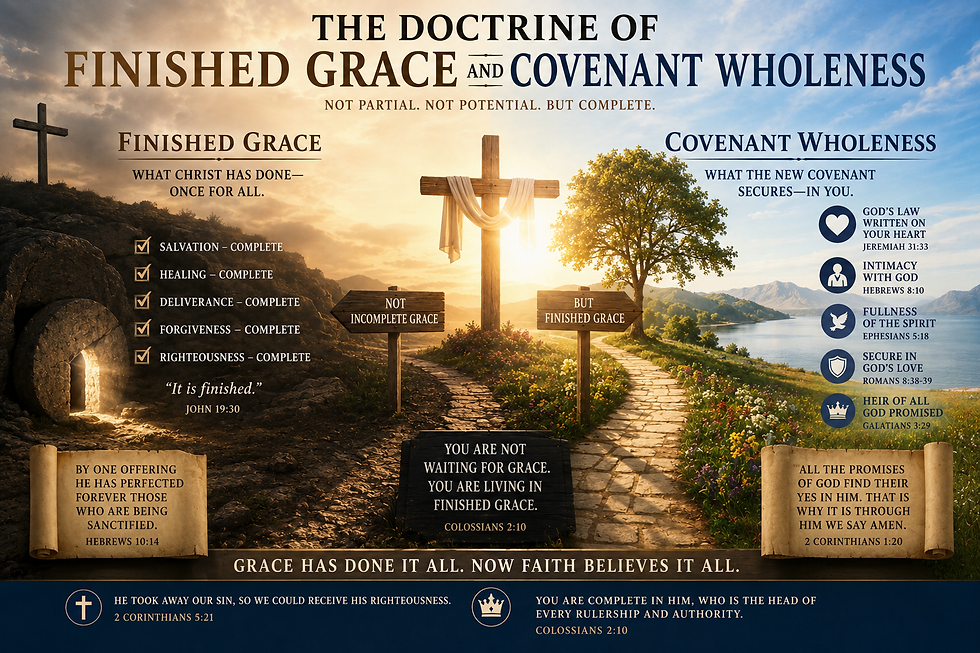
The Doctrine of Finished Grace and Covenant Wholeness is centered upon the belief that Jesus Christ completely fulfilled the work of redemption through His death, burial, and resurrection, establishing an eternal covenant of grace for all who believe. This doctrine teaches that salvation, righteousness, healing, freedom, identity, and divine provision are not rewards earned through human effort, but gifts fully secured through the finished work of Christ and received by faith.
At the center of this teaching stands the final declaration of Jesus upon the cross: “It is finished” (John 19:30). These words are understood not merely as the conclusion of His suffering, but as the announcement that the entire redemptive plan of God had been completed. The debt of sin was canceled, divine justice was satisfied, and reconciliation between God and humanity was fully accomplished.
According to Hebrews 10:10–14, Christ offered one sacrifice for sins forever and perfected those who are sanctified through Him. Colossians 2:13–14 further declares that the record of humanity’s transgressions was nailed to the cross, removing the barrier that separated mankind from God. Therefore, believers are not striving to achieve acceptance with God through religious performance or moral effort. Instead, they live from a position of acceptance already secured through Christ.
This doctrine strongly emphasizes righteousness by grace through faith. Ephesians 2:8–9 teaches that salvation comes by grace through faith and not through works, so that no one may boast. Romans 5:17 proclaims that believers receive an abundance of grace and the gift of righteousness, enabling them to reign in life through Jesus Christ. 2 Corinthians 5:21 reveals the divine exchange that took place at the cross: Christ, who knew no sin, became sin for humanity so that believers might become the righteousness of God in Him.
Within this framework, righteousness is not viewed as human moral perfection attained through discipline or religious law, but as a spiritual condition granted by God through union with Christ. The believer is therefore no longer identified by sin, guilt, or condemnation, but by grace, sonship, and covenant relationship with God.
The doctrine further teaches that believers possess a new identity in Christ. Colossians 2:9–10 declares that believers are complete in Him, while Galatians 2:20 teaches that the believer’s old life has been crucified with Christ and replaced by His indwelling life. First John 4:17 states, “As He is, so are we in this world,” revealing the believer’s spiritual union with Christ.
This identity is foundational to spiritual transformation. Rather than attempting to become accepted by God through external obedience, the believer grows through the revelation of who they already are in Christ. Transformation is understood to flow from inward spiritual life rather than outward religious striving.
The Doctrine of Finished Grace and Covenant Wholeness also teaches that healing and wholeness were included within Christ’s atoning work. Isaiah 53:4–5 prophesies that Christ bore griefs, sorrows, and wounds so that humanity might receive healing. First Peter 2:24 affirms that by His stripes believers were healed. Third John 1:2 expresses the desire that believers prosper and remain in health even as their souls prosper.
Healing within this doctrine is viewed not only as physical restoration, but as total wholeness encompassing spirit, soul, mind, emotions, and body. Christ’s redemption is understood to address every area of human brokenness. Faith is therefore seen not as an attempt to persuade God to heal, but as the act of receiving what Christ has already provided through redemption.
Divine provision and prosperity are likewise understood as covenant blessings flowing from grace. 2 Corinthians 8:9 teaches that though Christ was rich, He became poor so that believers through His poverty might become rich. Philippians 4:19 promises that God supplies every need according to His riches in glory by Christ Jesus. Deuteronomy 8:18 further declares that God gives His people power to obtain wealth.
Within this doctrine, prosperity is not merely defined as financial gain, but as the divine empowerment to flourish, succeed, fulfill purpose, and become a blessing to others. The life of Joseph is often presented as an example of covenant prosperity because Scripture states that whatever he did prospered since the Lord was with him. Prosperity is therefore viewed as the manifestation of God’s favor and presence operating within a believer’s life.
Another foundational aspect of this doctrine is freedom from the Law through the establishment of the New Covenant. Romans 6:14 declares that believers are no longer under law but under grace. Galatians 5:1 urges believers to stand fast in the liberty by which Christ has made them free. Hebrews 8:6–13 explains that Christ established a better covenant founded upon better promises.
According to this teaching, the Mosaic Law revealed sin but could not produce righteousness or spiritual perfection. Grace, however, transforms the believer internally through the indwelling presence of Christ. Obedience is therefore understood not as an attempt to earn salvation, but as the fruit of spiritual union with God.
The doctrine also recognizes that one of the greatest challenges believers face is the transformation of deeply rooted religious beliefs. Many individuals have been taught to relate to God through fear, performance, guilt, and continual striving. Because of this, the message of finished grace often challenges traditional systems that emphasize human effort and religious obligation.
Romans 12:2 teaches that believers are transformed by the renewing of their minds, while John 8:32 declares that truth brings freedom. This doctrine teaches that spiritual growth often requires a transition from a mindset shaped by condemnation and self-effort into one established in grace, sonship, and covenant completeness.
For many believers, this transition can be difficult because human nature naturally gravitates toward systems of merit and control. Grace removes human boasting and places total dependence upon Christ alone. As a result, the message of finished grace may conflict with legalistic traditions, fear-centered religion, and identity structures rooted in shame, failure, or religious performance.
The Apostle Paul addressed this conflict repeatedly in his writings, especially concerning those who attempted to combine grace with the Law. In Galatians 2:21, he warned that if righteousness could come through the Law, then Christ died in vain. The doctrine therefore teaches that believers must continually renew their understanding so that truth replaces bondage and grace replaces striving.
Ultimately, the Doctrine of Finished Grace and Covenant Wholeness proclaims that Jesus Christ fully completed the work of redemption and that believers are invited to live in the fullness of what He accomplished. Through faith, believers receive righteousness, healing, identity, provision, freedom, and spiritual wholeness apart from human effort.
This doctrine declares that the believer’s life is no longer defined by striving to obtain God’s favor, but by learning to walk in the fullness of what Christ has already finished. Grace becomes the foundation of the believer’s relationship with God, and faith becomes the means by which the completed work of Christ is received and experienced in everyday life.
Hebrews 4:10 “For anyone who enters God’s rest also rests from their works, just as God did from his.”


Comments